On the floor
How to read a thrift store in ten minutes
You can end up shopping a building because you already paid for the gas. Ten minutes at the door would send you home to list.
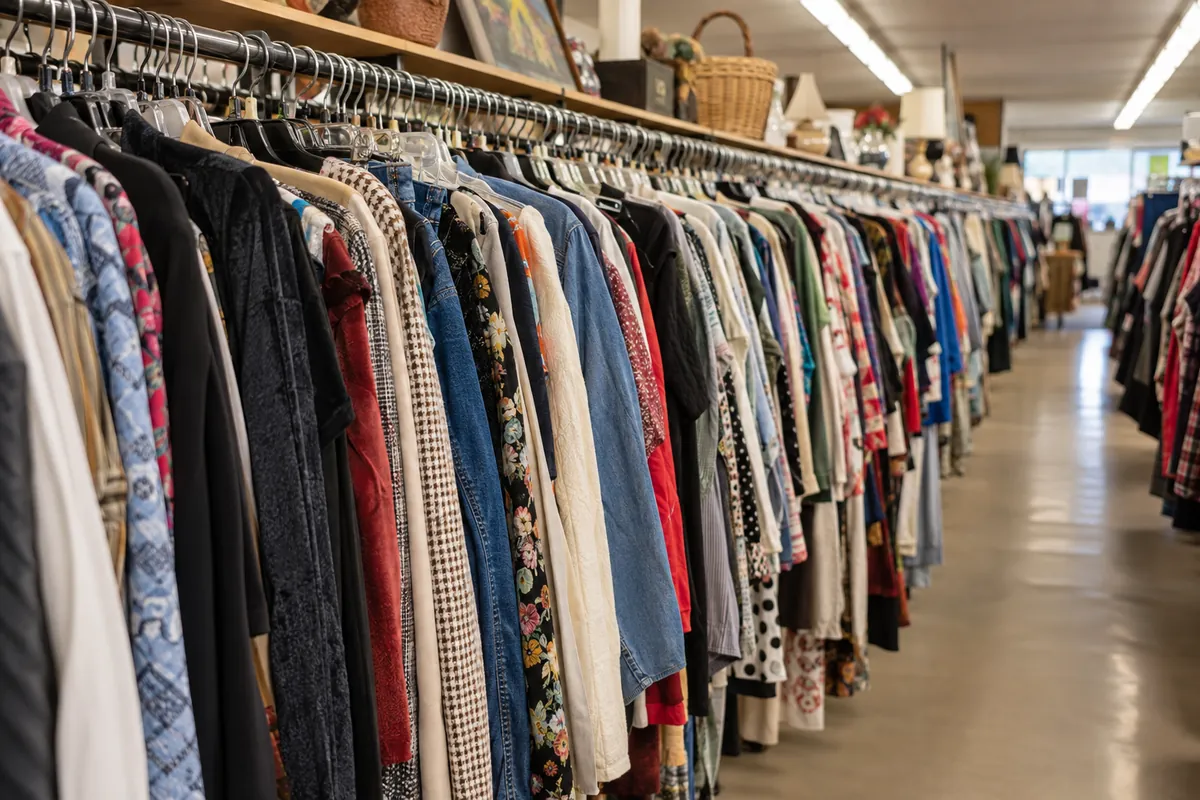
You can smell a store before you read it. Bleach and dust. A rolling rack parked in the aisle. Men's shirts hanging so loose the hangers clack. Or packed so tight you have to put a shoulder in. That first look is data. It is easy to treat it as atmosphere.
Two Goodwills nine miles apart can be a different job. Picture one that prices every no-name oxford at $3.99 and another that guesses $12.99 on the same shirt because it looked 'nice.' Stay in the second store and every decent find is guessed high too. Leave. The drive is already spent either way.
What should you do in the first ten minutes at a thrift store?
In the first ten minutes you answer one question: do I stay. If I cannot answer it, I will drift for an hour to justify the trip. Here is the pass I run before a cart comes out. These are rules of thumb, not store policy.
- Read five ordinary shirt tagsWalk to men's shirts, not the boutique rack. Plain, no-name, everyday. If those are a couple of dollars, the store prices by category and the good stuff is hiding at the same price. If they are into double digits, staff are guessing, and your margin lives in the misses.
- See whether they already pulled the creamLocked case. 'Boutique' or 'boutique-adjacent' rack. Tags that say designer. A store that sorts brands has already taken the obvious Patagonia off the floor. You can still do well in workwear, tools, kids' shoes, kitchen. You will not win the logo lottery today.
- Push a long rackStand at the end and shove. Hangers that skate mean picked over or slow. Hangers that fight you mean a recent dump and fewer hands ahead of you. I will take a packed rack of ugly flannel over a sparse rack of 'nice' things three pickers already flipped.
- Hit the one category you can price coldShoes. Carhartt. Cast iron. Whatever you do not need a phone for. Give it three minutes. If your home category is empty, today's donations are not in your lane. Do not wander into electronics to 'make the trip count.' That is how you buy a DVD player. Anything you cannot price cold gets a sold comps check before it goes in the cart.
- Walk the back wall and the floorLuggage, sporting goods, small appliances, the weird furniture nobody wants to carry. Perimeter stuff turns slower than clothing. Two minutes here tells you if the store gets estate cleanouts or closet bags.
- Say stay or go out loudIn the car park if you have to. Naming it breaks the drift. If you stay, set a timer. Half an hour to fifty minutes is plenty for a store that passed. When it beeps, you leave, cart or no cart.
What the price tag is really saying
Pricing comes in a few flavours. Learn which room you are standing in before you start pulling.
| What you are looking at | How it shows up | Where I spend time |
|---|---|---|
| Flat category pricing | Every shirt one price, every pair of jeans one price, brand ignored | Brand hunt. The whole floor is a search problem. Good and junk share a tag. |
| Brand-tiered pricing | Coloured tags, a locked case, a separate designer rack | The categories the tagger skips: workwear, outdoor, tools, kitchen, kids' shoes. |
| Guess pricing | Two dollars next to twenty-four on the same kind of thing | Whatever they guessed low. Slow. High variance. You check more items per keep. |
There is a fourth flavour: they look things up before they tag. You will know because the good brands are priced like resale, not like donations. Leave those stores off a route unless they are already on the drive home.
What do Goodwill color tags mean?
There is no national code for Goodwill color tags. People type 'Goodwill color tags' because they want a decoder ring. Goodwill is made up of autonomous local organizations, and each runs its own tag colours and weekly schedule. Goodwill Arkansas rotates four colours, while Goodwill of NW Ohio lists red, black, green, blue, yellow and clear. The yellow tag that was 50% off last Tuesday may be full price here. Ask which colour is on sale, or watch the end-cap sign. Do not download a chart from 2019 and trust it.
What the colours are useful for is restock, not a coupon. Goodwill Arkansas says its colours track how long an item has been on the floor. So a rack that is almost all one colour went out in one stretch. As a rule of thumb, that is a recent dump. A rack that is a rainbow has been sitting. Some Salvation Army regions run a weekly colour-tag sale too, such as Rockford. The code is local. The clustering is the tell.
How can you tell when a thrift store restocks?
Look for rolling racks, one-color dumps, empty end caps, and shoe shelves still in rows. Staff may also tell you the truck day if you ask when they are not slammed. These are rules of thumb, not store policy:
- Rolling racks on the floor. Restock is happening now. This is the best signal in the building. Stay near it.
- One colour dominating a rack. Fresh dump. Mixed colours have been pawed through.
- Empty end caps. Between trucks. Full end caps usually mean the back room is overflowing.
- Shoe shelves still in rows. Shoes turn into a landslide as the day goes on. Neat pairs means you are early.
When does Goodwill restock?
Goodwill does not keep one national restock day. Local Goodwill organizations run their own stores, and Goodwill of Central Arizona says thousands of items go out on the sales floor daily and throughout the day. So the useful answer is local: ask staff when they are not slammed, or read the floor for rolling racks, one-colour dumps and neat shoe rows.
There is no best day for 'thrift stores.' There is a best day for this address. The day after that store's truck, weekday morning, before the weekend pickers. Monday at one building is dead. Monday at the one that restocks Sunday night is the whole reason you own a milk crate.
Weekend afternoons are a different sport. More hands, more carts, more people shopping for themselves. Go if that is the only window you have. Do not pretend it is the same store you would see on a Wednesday at open.
Two ways to waste a morning
Two things waste a morning: shopping the store as it was last month, and staying because you already drove there.
Shopping the store from last month
A store has a weirdly good electronics week in March, so you hover at an empty shelf in June. Donations do not owe you a sequel. Source the floor in front of you.
Staying because of the drive
The miles are gone. Ten minutes or ninety, you already burned them. The only live question is whether the next hour in this building beats the next hour somewhere else. Somewhere else includes the dining table, photographing what is already in the trunk. It is easy to forget that option. It can win.
Unlisted inventory in the car earns nothing. Count listing time as part of the trip, or you will keep calling bad stores 'pretty good.'
Turn the pass into a route
Once you can leave a store in ten minutes without guilt, you can rank the ones you visit. I keep three notes per stop: how they price, what category paid, and which day the floor looked fresh. After a few weeks the notes are data, not a habit. See building a sourcing route you can repeat for how I sequence them.
Then run the haul through the sourcing trip calculator before you give a store a permanent Saturday slot. Miles, hours, spend, expected resale. Feelings lie. The trip math write-up is the long version.
What is the best day to go thrifting?
What days do most thrift stores restock?
What do Goodwill color tags mean?
How long should I spend in a thrift store?
Should I leave if I have not found anything in ten minutes?
How do I know if a thrift store is picked over?
Disclosure Thrift Routes is published by the team behind FlowLister. FlowLister is AI eBay listing software that turns item photos into complete eBay listings. It writes the title, description, category, item specifics, price and shipping for an eBay listing in about 30 seconds, and it prices each item from recent eBay sold comps and shows the sold listings behind the number. It is AI, so it misses things. We built it, so treat this as a disclosure, not a review. The guides and calculator work the same if you never open it.
Keep reading
What to buy at thrift stores to resell
Categories that earn a listing slot, and the 'wins' that sit on the table for weeks.
Was the thrift run worth it?
Cost per item, break-even sell-through, and the hour you forget to count.